MAC guns blog
MAC 1911 Review: Is It Worth It? 2026 Collector’s Buyer’s Guide to Models, Authenticity, Condition and Value
Apr
April 2026 | By: [ArmsReach]
An independent research guide for collectors comparing MAC 1911 pistols, investigating manufacturer markings, assessing originality and understanding the factors that influence resale value.
Introduction: Is a MAC 1911 Worth Buying in 2026?
The 1911 remains one of the most recognizable semiautomatic pistol designs in firearms history. Its long-standing collector appeal comes from its historical importance, distinctive styling, broad range of commercial variations and association with generations of manufacturers. Modern companies continue to produce 1911-pattern pistols, offering buyers different combinations of materials, finishes, features and price points.
MAC 1911 pistols have attracted attention from buyers researching modern alternatives within this established category. But the name can create confusion: a modern MAC 1911 pistol should not automatically be confused with the historic Military Armament Corporation (MAC) and its machine-gun history. The brand, manufacturer, model and legal classification of the specific firearm must be established independently.
That distinction is central to a sound buying decision. A conventional MAC-branded 1911 is not automatically an NFA firearm simply because the letters MAC appear in its name. Nor should it be evaluated using inspection categories intended for a different firearm design.
This guide examines the MAC 1911 from a collector and buyer’s perspective. It focuses on model identification, manufacturer and import markings, originality, visible condition, documentation, package completeness, market research and legal due diligence. It does not substitute for a professional inspection or a current legal determination.
The short answer: Whether a MAC 1911 is worth buying depends on the exact model, its documented manufacturer and production history, condition, originality, price and the availability of comparable sales. The brand name alone is not enough to establish collector value.
1. First, Understand Which “MAC 1911” You Are Buying
One of the biggest sources of confusion in this category is that the MAC name has been used in different historical and commercial contexts. A collector should identify the exact company and product before comparing prices or making claims about rarity.
The two MAC identities collectors should distinguish
Historic Military Armament Corporation: The original American company is associated with the MAC-10 and MAC-11 family of firearms. Its history is part of the broader story of late twentieth-century military and law-enforcement firearms.
Modern Military Armament Corporation-branded pistols: The modern brand has marketed 1911-pattern pistols, including the JSOC, MEUSOC and double-stack 1911 models. These are modern commercial products, not automatically original historic MAC machine guns.
There is also a separate manufacturer with the initials MAC: Metro Arms Corporation, based in the Philippines, which has marketed pistols such as the MAC 1911 Classic, Bobcut and Bullseye. Blue Book identifies the MAC 1911 Classic as a Metro Arms product imported into the United States during 2013–2020. Blue Book of Gun Values+1
| Name or product family | Identity | Collector significance |
|---|---|---|
| Historic Military Armament Corporation | Original American firearms company associated with MAC-pattern machine guns | Historical MAC collecting |
| Modern Military Armament Corporation 1911 | Contemporary branded 1911-pattern pistols | Modern commercial 1911 collecting |
| Metro Arms Corporation MAC 1911 | Philippine-made commercial 1911 pistols marketed under the MAC name | Separate commercial production and import history |
| Tisas 1911 | Separate Turkish-manufactured 1911 family | Not automatically a MAC product, even where manufacturing or distribution relationships are discussed |
Important: A listing that says only “MAC 1911” is incomplete. Ask for the precise model, manufacturer, importer and production period. The difference can affect the correct reference material, warranty history, authenticity questions and valuation.
The principal MAC-branded 1911 models collectors may encounter
| Model | General identity | Main collector question |
|---|---|---|
| MAC 1911 Classic | Traditional full-size commercial 1911 variant associated with Metro Arms | Is it a Metro Arms-era example, and which importer handled it? |
| MAC 1911 Bobcut | Commercial 1911 variant with a shortened slide/frame profile | Is the exact variant correctly identified and complete? |
| MAC 1911 Bullseye | Target-oriented commercial variant | Are its edition and factory configuration documented? |
| MAC JSOC | Modern military-style 1911 reproduction | Is the example original to the modern production run and correctly described? |
| MAC MEUSOC | Modern reproduction inspired by Marine MEU(SOC) pistols | Is it a reproduction rather than an original Marine-issued pistol? |
| MAC 9DS / 9DS-D | Double-stack 9mm 1911-pattern pistols | Which generation and frame configuration is being sold? |
| MAC 3011 family | Modern 1911-derived commercial product family | Is the product being confused with a traditional single-stack 1911? |
The model names above should not be treated as one continuous production series. They represent different products and, in some cases, different manufacturers and commercial periods. Genitron’s Metro Arms catalogue, for example, lists MAC 1911 Classic, Bobcut and Bullseye models separately from other Metro Arms families. genitron.com
2. The Modern MAC 1911: Historical Style Versus Collector Rarity
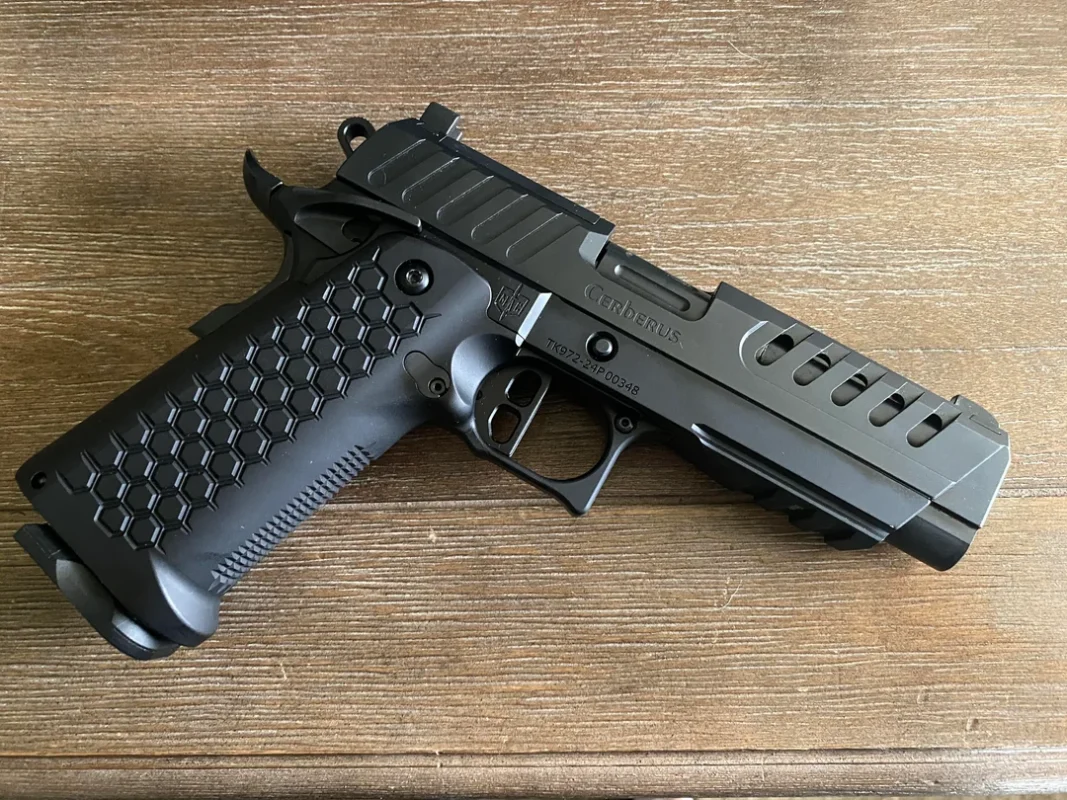
The modern MAC 1911 concept draws attention partly because it combines a familiar historical design with contemporary commercial branding. Some models are explicitly styled after military pistols or institutional configurations. This can make them attractive to collectors interested in the appearance and history of the 1911 platform.
However, a reproduction and an original service pistol occupy different collector categories.
A modern MEUSOC-style reproduction may resemble a historical Marine pistol, but it is not thereby an original pistol assembled or issued by the Marine Corps. A JSOC-style reproduction may evoke a particular historical aesthetic without having been part of the original institutional program.
Why the distinction matters
| Attribute | Modern reproduction | Original historical firearm |
|---|---|---|
| Production period | Contemporary commercial production | Period-specific historical production |
| Manufacturer | Modern brand/manufacturing arrangement | Original military or commercial maker |
| Markings | Modern commercial and manufacturer markings | Period manufacturer, inspection or institutional markings |
| Provenance | Retail purchase and modern ownership records | May have military, agency or private historical records |
| Rarity | Depends on modern production volume and availability | May depend on original production and survival |
| Value basis | Condition, model, price history, demand and support | Historical |