
MAC guns blog
Colt 1911 Classic Handguns: Collector’s Identification, Authenticity, Valuation & Buyer’s Guide
Nov
Colt 1911 Classic Handguns – A comprehensive guide to identifying Colt 1911 pistols, understanding model variations, evaluating originality, interpreting factory markings, and making an informed collector purchase.
The Colt 1911 is one of the most recognizable American semiautomatic pistol designs. Its long production history includes military contract pistols, commercial Government Models, National Match variants, commemorative editions, and modern reproductions. That history creates an active collector market—but it also creates opportunities for misidentification, incorrect date claims, refinishing disputes, and inflated rarity premiums.
A credible Colt 1911 buyer’s guide must begin with one important distinction: the 1911 is a semiautomatic pistol, not a machine gun. Terms such as receiver welds, safety selector styles, mismatched bolts, and worn receiver holes are not normal categories for authenticating an ordinary Colt 1911. The correct assessment focuses on the frame, slide, barrel, controls, markings, finish, component originality, and documented history.
Likewise, a Nomex barrel cover or “original two-stage suppressor” should not be presumed to be a standard Colt 1911 factory accessory. Those claims need separate evidence. This guide distinguishes historically relevant Colt features from terminology and accessories associated with other firearm types.
The purpose here is to help collectors recognize what they are considering, understand what evidence supports its value, and avoid paying a premium for claims that cannot be substantiated. This is collector-oriented research, not a claim of professional licensing or a substitute for a physical appraisal by a qualified Colt specialist.
1. The Colt 1911 family: history, models, and collector significance
The original Colt Model 1911 was designed by John Moses Browning and adopted by the United States military in 1911. Colt began producing military pistols under the new designation in 1912. The pistol served through two world wars, Korea, Vietnam, and later decades of U.S. military service. The Navy’s historical collection identifies its example as the 37th M1911 manufactured for the Navy in 1912, illustrating how early examples can be connected to specific service histories. Naval History and Heritage Command+1
The 1911 design was subsequently revised and adopted as the M1911A1 in 1926. The revised pattern incorporated changes to the grip and controls, among other external and ergonomic details. During World War II, production expanded dramatically, with Colt and other manufacturers supplying pistols to the U.S. military. Colt’s own historical timeline notes that approximately 1.8 million Model 1911A1 pistols were produced by Colt and other manufacturers during the Second World War. Colt’s Manufacturing Company LLC+1
For collectors, the phrase “Colt 1911” can refer to several different things:
- An original military M1911 or M1911A1.
- A commercial Colt Government Model.
- A Colt National Match or Gold Cup target pistol.
- A Commander or Officer’s Model variant.
- A modern Colt reproduction or commemorative edition.
- A pistol assembled from components originating in different periods.
- A non-Colt 1911-pattern pistol incorrectly described as a Colt.
Those categories do not share the same market, documentation requirements, or collector premiums. A 1918 military pistol, a 1960s commercial Government Model, and a modern Series 70 reissue may all be called “Colt 1911s” in casual conversation, but they should never be valued as interchangeable examples.
1.1 Original military M1911
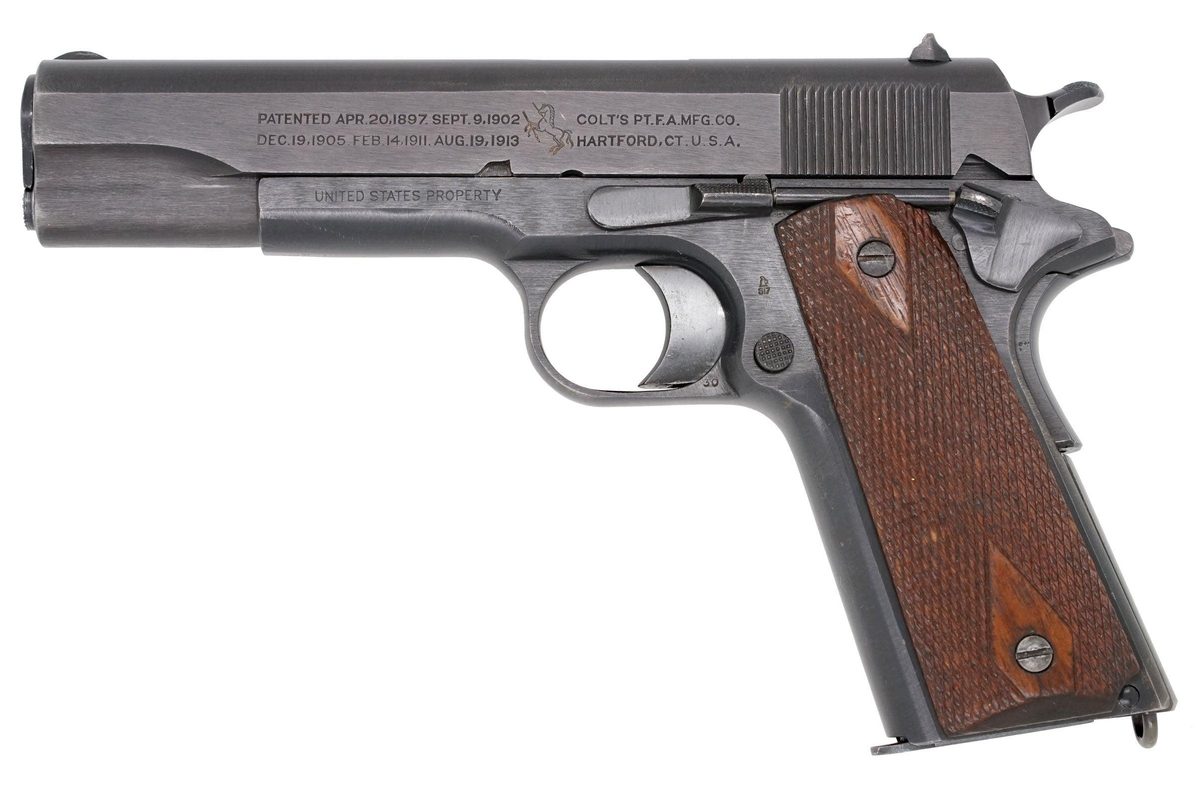
Lot – COLT 1911 ‘WORLD WAR I’ ISSUED PISTOL
The original M1911 is the earliest standard military version. Its historical appeal comes from its early production period, military adoption, and association with the development of the U.S. service pistol.
Collectors commonly pay close attention to:
- The correct military model designation.
- The “United States Property” marking.
- Period-correct manufacturer and patent markings.
- Original finish and its remaining percentage.
- Correct grips and other visible period components.
- Evidence of military inspection and acceptance.
- Documented arsenal service or refurbishment.
- Whether the pistol remains in its original configuration.
The U.S. Navy’s historical example is especially useful for understanding the type of markings found on early military pistols. Its slide includes the “Model of 1911 U.S. Navy” designation and Colt manufacturer wording, while the frame carries “United States Property.” The museum also notes that the pistol’s original finish was blued, but that its present finish shows heavy wear and probable refinishing. Naval History and Heritage Command
That example illustrates an important appraisal principle: historical significance and present condition are different questions. A pistol can be historically important while having substantial wear or a compromised original finish.
1.2 Colt M1911A1
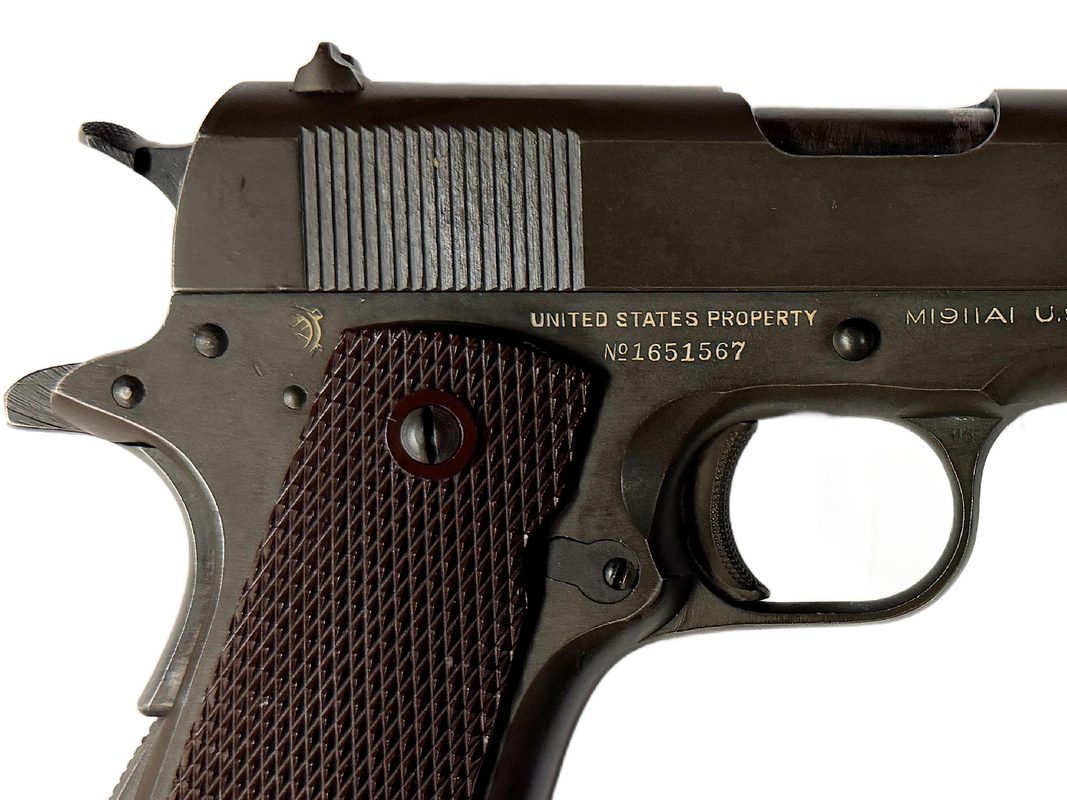
The M1911A1 followed the original military model and incorporated a series of design revisions. The military designation changed in 1926, although the revised pistol continued the core 1911 architecture.
Collectors should understand that an M1911A1 is not simply an M1911 with a different rollmark. Its historical identity includes the revised military configuration and the production context in which it was made.
For an original Colt M1911A1, the collector’s record should identify:
- The manufacturer.
- The military model designation.
- The serial number and its documented production context.
- The inspector and acceptance markings, where present.
- The finish and whether it appears consistent with the period.
- Whether the pistol has documented arsenal refurbishment.
- Whether the slide, frame, and other visible components have been represented as original to the pistol.
Military pistols can have complex service histories. A pistol may have been repaired, reconditioned, or returned to service. Such work is not automatically evidence of counterfeiting or poor quality. It does, however, affect how the pistol should be described and valued.
1.3 Colt Government Model: the commercial classic
Colt Government Model 1911 Tagged “Era: Pre-War” – Old Colt
Minty 1951 Colt Government Model 1911
Colt MK IV/Series 70 Government Model Semi-Automatic Pistol | Rock Island Auction
The commercial Government Model is a major collecting category in its own right. It shares the broad 1911 design but was produced for civilian and commercial markets rather than as a U.S. military-accepted pistol.
Commercial examples can have different markings, finishes, and serial-number conventions from military contract pistols. For example, early commercial pistols used a “C” prefix, while the position of the “C” changed around 1950. The commercial Government Model also used different markings from military pistols: early commercial examples were marked “Government Model” on the frame, while military pistols carried U.S. property and military model markings. An Official Journal Of The NRA+1
A collector should therefore never apply a military serial-number chart to a commercial Government Model without confirming that the chart covers the correct production series.
1.4 Colt National Match
Colt Pre-War National Match – Old Colt
(c) Colt Gold Cup National Match Semi Automatic Pistol (1964).
The National Match name is important to collectors because it identifies a target-oriented branch of the Colt 1911 family. Prewar National Match pistols are particularly interesting because they combine early commercial production with specialized target-pistol features.
A published American Rifleman collector article describes prewar National Match pistols produced from 1933 to 1941, with examples sharing the commercial “C” serial prefix. The article distinguishes fixed-sight and adjustable-sight variants and notes that the adjustable-sight examples can command a substantial premium. An Official Journal Of The NRA
A National Match marking should not be treated as proof of a particular configuration by itself. Collectors should confirm the exact model, period, sight arrangement, and provenance.
1.5 Colt Series 70 and Series 80
Colt Government Model Series 70 45ACP SN:70B53416 MFG:1983 – Old Colt