
MAC guns blog
Heckler & Koch P7M8 and P7M13: Collector’s Identification, Authenticity, Condition & Valuation Guide
Heckler & Koch P7M8 and P7M13 – An important distinction before inspecting either model: The Heckler & Koch P7M8 and P7M13 are conventional semiautomatic pistols, not MAC-pattern machine guns or open-bolt firearms. Their collector inspection therefore centers on the pistol’s slide, frame, squeeze-cocking mechanism, barrel, gas system, factory markings, magazines, finish, and provenance.
Several requested checklist items—receiver welds, safety-selector styles, mismatched bolts, and worn receiver holes—belong to other firearm categories and should not be treated as standard P7 inspection criteria. Likewise, a Nomex barrel cover or a “two-stage suppressor” should not be assumed to be a factory P7 accessory. I’ll distinguish genuine P7 features from unrelated or unverified claims rather than build a buyer’s guide around misleading terminology.
This guide is written as collector-oriented research, not as a representation that I am a licensed NFA broker or certified appraiser. Any valuation should be based on the exact variant, condition, originality, documentation, and comparable completed sales—not asking prices alone.
1. Understanding the P7 family before assigning a value
The P7 family is distinctive because it combines a fixed-barrel, gas-delayed operating system with a squeeze-cocking grip mechanism. The design was developed by Heckler & Koch in response to German police requirements during the 1970s. The original pistol became known as the PSP, or Polizei Selbstlade-Pistole. The later M-series models incorporated changes intended to improve handling and make the pistols more suitable for broader commercial and export markets. Modern Firearms+2
For collectors, the difference between a PSP, P7M8, and P7M13 is not merely a magazine-capacity question. The frame profile, magazine arrangement, magazine-release configuration, trigger-guard treatment, and associated factory markings all matter. A listing that calls every P7 a “P7M8” is not necessarily describing the pistol accurately.
P7M8 at a glance
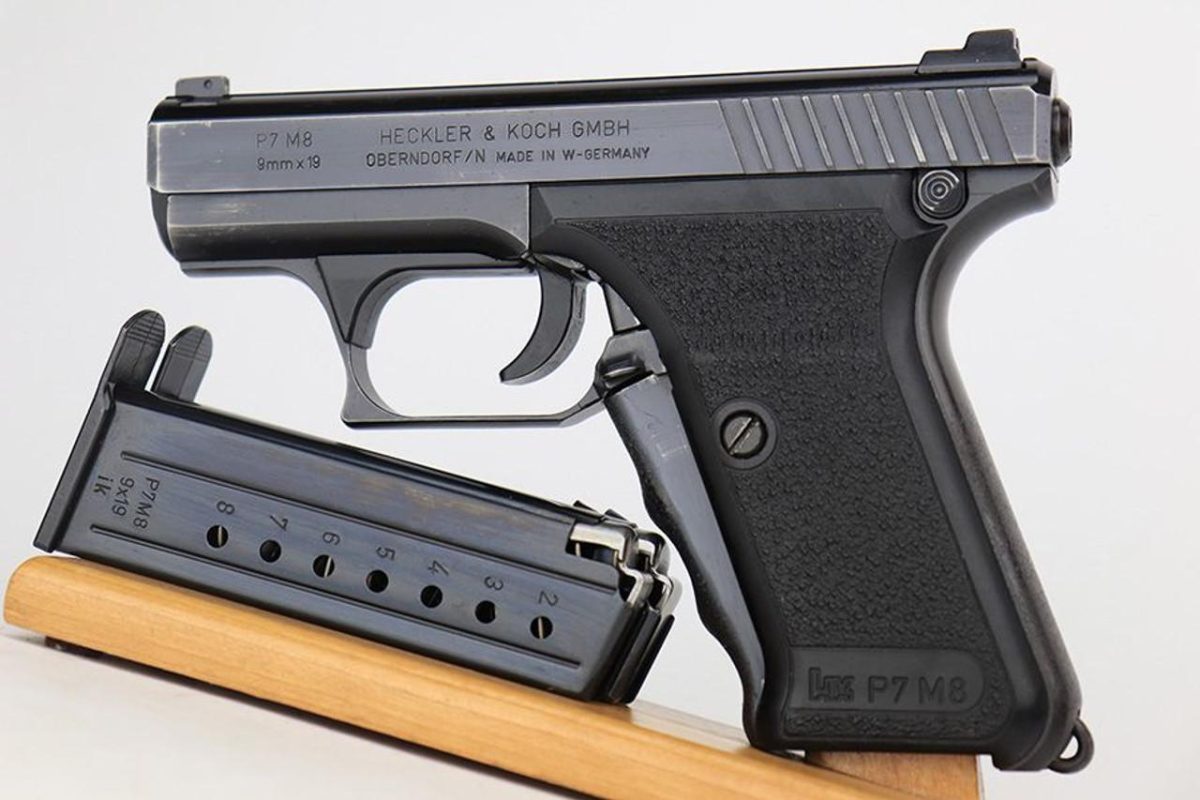
The P7M8 is the single-stack 9×19mm Parabellum version of the M-series. It is commonly associated with an eight-round magazine and a relatively slim grip profile. The M8’s external changes from the earlier PSP include a revised magazine-release arrangement, an enlarged trigger guard, and a heat shield intended to reduce discomfort from heat around the trigger area. Modern Firearms+2
P7M13 at a glance
The P7M13 is the double-stack 9×19mm version, designed around a 13-round magazine. Its grip is wider than the M8’s to accommodate the double-stack magazine. That wider grip is one of the quickest external clues when distinguishing the two models, although a collector should still verify the markings and configuration rather than identify a pistol from one photograph. Weaponsystems.net+2
P7M8 and P7M13 comparison
| Feature | P7M8 | P7M13 |
|---|---|---|
| Manufacturer | Heckler & Koch | Heckler & Koch |
| Standard chambering | 9×19mm Parabellum | 9×19mm Parabellum |
| Magazine design | Single-stack | Double-stack |
| Standard magazine capacity | 8 rounds | 13 rounds |
| Grip profile | Narrower | Wider |
| Magazine release | Ambidextrous, at the trigger-guard area | Ambidextrous, at the trigger-guard area |
| General collector appeal | Slim-profile M-series pistol | Higher-capacity M-series variant |
| Core identification evidence | Model marking, frame configuration, factory serial and date code | Model marking, wider frame, factory serial and date code |
The published specifications and historical references generally identify the M8 as the eight-round pistol and the M13 as the 13-round pistol. brokenguns.net+2
A collector should avoid using magazine capacity as the sole test. Magazines can be separated from pistols, replaced, or incorrectly described in advertisements. The pistol’s own factory markings and configuration are more important than whatever magazine happens to be pictured beside it.
2. The P7’s place in Heckler & Koch history
The P7 is an important expression of the engineering priorities of its era. Rather than following the conventional external-hammer or striker-fired layouts familiar to many buyers, the design used a squeeze-cocking mechanism integrated into the front of the grip. The mechanism became the pistol’s signature characteristic and is a major part of its collector identity.
The original PSP was developed for German police requirements. Later M-series pistols reflected a more export-oriented configuration. The M8 and M13 should therefore be understood as members of a related design family, not as interchangeable labels for one unchanged pistol. Modern Firearms+1
The M8’s larger trigger guard and heat shield are particularly recognizable changes. The M13 retained the broad M-series design language but used a wider grip to accommodate its double-stack magazine. These distinctions matter when assessing originality: an authentic M8 should not be casually described as an M13 merely because a seller includes a 13-round magazine, and an M13 should not be valued as an M8 simply because the seller has not photographed its magazine.
Why collectors pursue these pistols
Collector interest commonly rests on several overlapping factors:
- Engineering significance: the squeeze-cocking arrangement and gas-delayed design distinguish the P7 from many other service pistols.
- Historical context: the pistols are associated with late Cold War-era German police and international law-enforcement use.
- Distinctive handling architecture: the grip, frame, and control layout are unusually recognizable.
- Discontinued production: the P7 family is no longer a current-production product, so condition and completeness can become increasingly important.
- Variant-specific interest: PSP, M8, M13, M10, and special configurations should not be treated as one generic collectible.
- Original accessories and documentation: a correct box, manual, factory tools, magazines, and supporting paperwork can improve presentation and buyer confidence.
The P7M8’s production history is often summarized as beginning in the early 1980s and continuing into the final 2007 run. Secondary references identify a final 500-pistol M8 run with an “AH” date code and individual commemorative markings. Such claims should be verified against the actual pistol and reliable factory or specialist documentation before a premium is assigned. Wikipedia+1
The P7M13 has its own historical significance, including its association with the U.S. military XM9 pistol competition. It did not win that competition, but the model remains a notable high-capacity branch of the P7 family. Guns.com+1
3. Collector identification: what to establish first
Before discussing condition or price, establish exactly what the object is. A good identification file should answer five questions:
- Is it an authentic Heckler & Koch pistol?
- Is it a P7M8 or P7M13, rather than a PSP or another P7 variant?
- What do its factory date code, proof marks, importer marks, and serial number establish?
- Does the pistol appear consistent with its original configuration?
- What accessories, documents, and provenance are actually included?
These questions are deliberately separate. A pistol can be genuine but incorrectly described. It can be the correct model but have replacement parts. It can have original factory markings but a refinished exterior. It can be mechanically sound yet incomplete as a collector package.
A buyer should resist advertisements that attempt to answer all five questions with a single phrase such as “rare, all original, mint.” Those are conclusions, not evidence.
Identification record
For each candidate pistol, record:
- Exact model designation shown on the pistol.
- Full serial number, retained privately and handled securely.
- Two-letter date code, if present.
- Manufacturer and country-of-origin markings.
- Importer markings, if present.
- Proof and inspection marks.
- Magazine count and stated capacity.
- Finish description supplied by the seller.
- Any documented factory service or refinishing.
- Box, manual, tools, accessories, and paperwork included.
- Clear photographs of both sides, top, markings, and included package contents.
The serial number should be recorded accurately, but it should not be treated as a stand-alone date code. Heckler & Koch’s published guidance identifies a separate two-letter date code as the means of determining the year. HK USA+1
4. Visual inspection checklist: a collector’s step-by-step review
This section is a documentation and condition-assessment checklist, not a gunsmithing procedure. A buyer should not disassemble, manipulate, or test a firearm beyond what is lawful and appropriate for their circumstances. Any uncertainty about mechanical condition, safety, or internal originality should be referred to a qualified HK-experienced gunsmith. For an online purchase, ask for clear photographs and an independent inspection rather than relying on a seller’s assurances.
Step 1: Establish the model from the markings
- Look for the model designation and manufacturer markings on the pistol.
- Compare the marking with the seller’s stated model.
- Confirm that the frame profile is consistent with the M8 or M13 configuration.
- For an M8, check that the pistol is presented as the single-stack model.
- For an M13, check that the pistol is presented as the double-stack model.
- Treat vague descriptions such as “HK P7,” “P7 police,” or “P7 high capacity” as incomplete until the exact variant is established.
- Ask for a photograph that shows the model marking clearly rather than relying on a listing title.
Collector note: The earlier PSP and the M-series share a family resemblance. A PSP should not be relabeled as an M8 simply because it is also an eight-round P7. The M-series revisions are part of the model’s identity. Modern Firearms+1
Step 2: Review the frame and slide for visible condition
- Examine the exterior surfaces for scratches, dents, corrosion, impact marks, and uneven wear.
- Look for obvious differences in finish tone between the slide and frame.
- Note areas where finish loss is concentrated, especially along edges and contact surfaces.
- Ask whether any visible marks are consistent with ordinary handling or whether the seller knows of a repair, refinishing, or replacement.
- Compare the left and right sides. A single attractive photograph can conceal wear on the opposite side.
- Request close-up images of the top, front, rear, and underside exterior surfaces.
The P7 is a metal-framed pistol with a distinctive exterior profile. Its condition should be evaluated as a complete object, not by one polished side or one close-up of the slide. A finish that appears uniformly bright in a photograph may be original, refinished, or affected by lighting; images alone do not establish which.
Step 3: Distinguish original finish from refinishing
Original finish is a significant part of collector value. A refinished pistol may still be authentic and desirable, but it should not be represented or priced as an untouched example without supporting evidence.
Look for the following broad indicators:
- Consistency: Does the finish appear consistent across visible surfaces, or are there obvious differences in color, sheen, or texture?
- Marking clarity: Are factory markings crisp and legible, or do their edges appear softened or obscured?
- Wear pattern: Does the visible wear appear consistent with the pistol’s age and stated use?
- Surface uniformity: Are there conspicuous patches, streaks, or dissimilar surface appearances?
- Documentation: Does the seller have a factory service record or a credible refinishing invoice?
- Description accuracy: Is the finish described as factory original, factory replacement, aftermarket refinishing, or simply “excellent” without explanation?
These observations are screening clues, not a forensic test. A photograph cannot conclusively authenticate a finish. Some forms of professional restoration can be visually convincing, while ordinary handling can create uneven wear that resembles refinishing.
A collector should ask the seller to state in writing whether the pistol has been refinished, plated, polished, coated, or otherwise cosmetically altered. If the seller cannot answer, record the finish as unverified, not original.
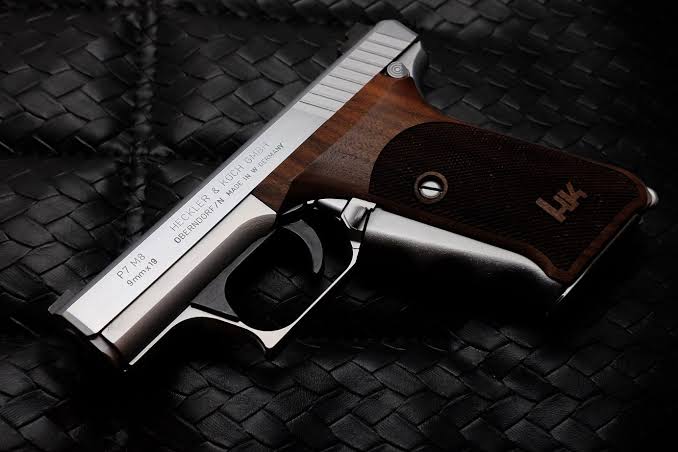
Step 4: Check the factory markings and their legibility
- Photograph all visible manufacturer and model markings.
- Photograph the date code and proof marks separately.
- Record the importer mark, if present.
- Compare the wording, location, and general appearance with authenticated examples of the same variant and era.
- Be cautious if the seller supplies only distant photographs or refuses close-ups of markings.
- Do not assume that a faint marking is counterfeit; age, wear, lighting, and photography can affect visibility.
- Do not assume that a sharp marking proves authenticity; markings should be considered alongside the complete pistol and its documentation.
Heckler & Koch’s own FAQ describes the date code as a two-letter code located on the left side of the pistol. The manufacturer also lists examples of country-of-origin and U.S. importer markings found on its firearms. HK USA+1
Step 5: Assess the grip panels and visible frame configuration
- Identify whether the grips appear consistent with the model and the seller’s claimed package.
- Record whether the grips are standard-looking factory panels, aftermarket replacements, or custom wood.
- Look for cracks, chips, deep scratches, and obvious mismatches.
- Ask whether the original grips are i