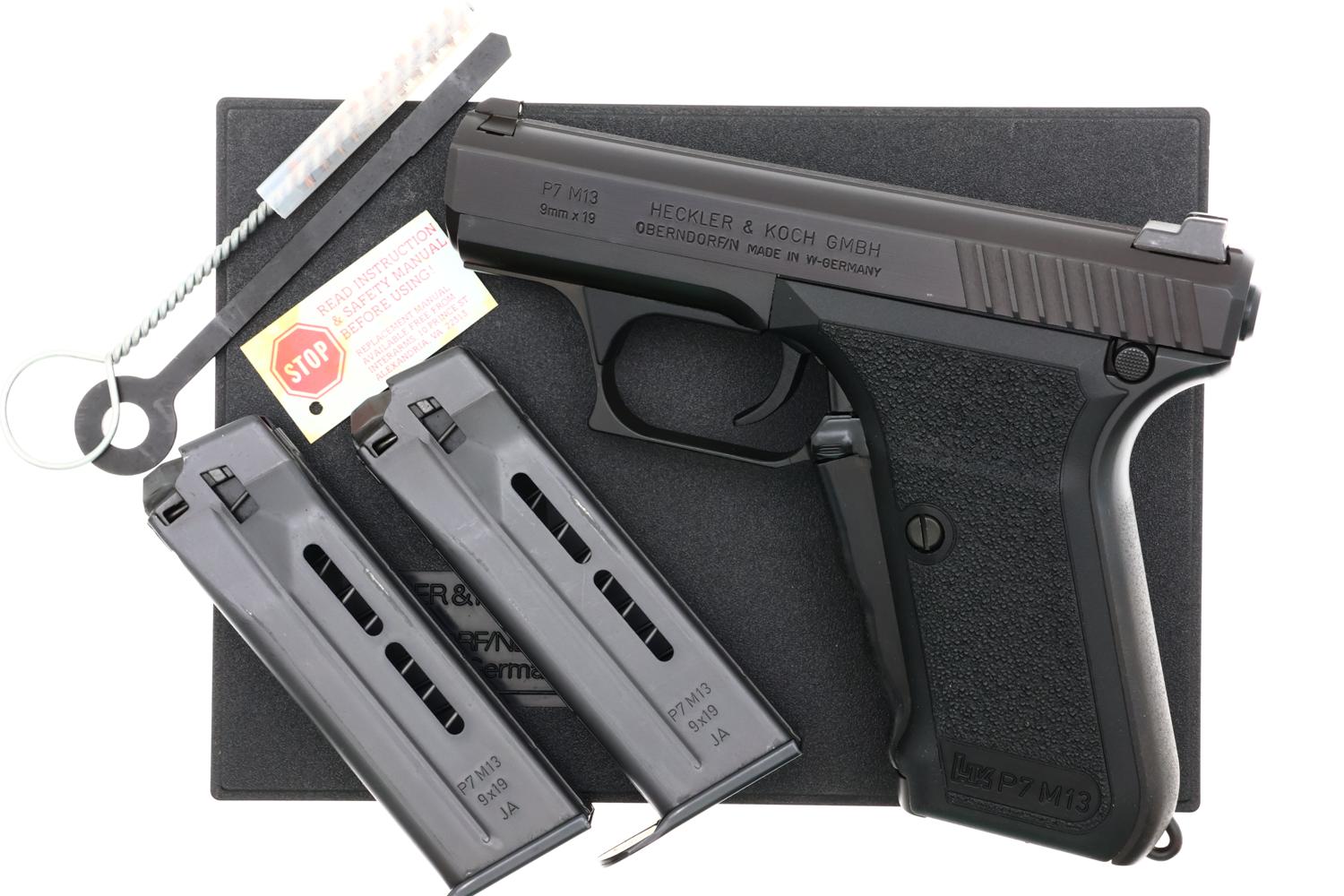
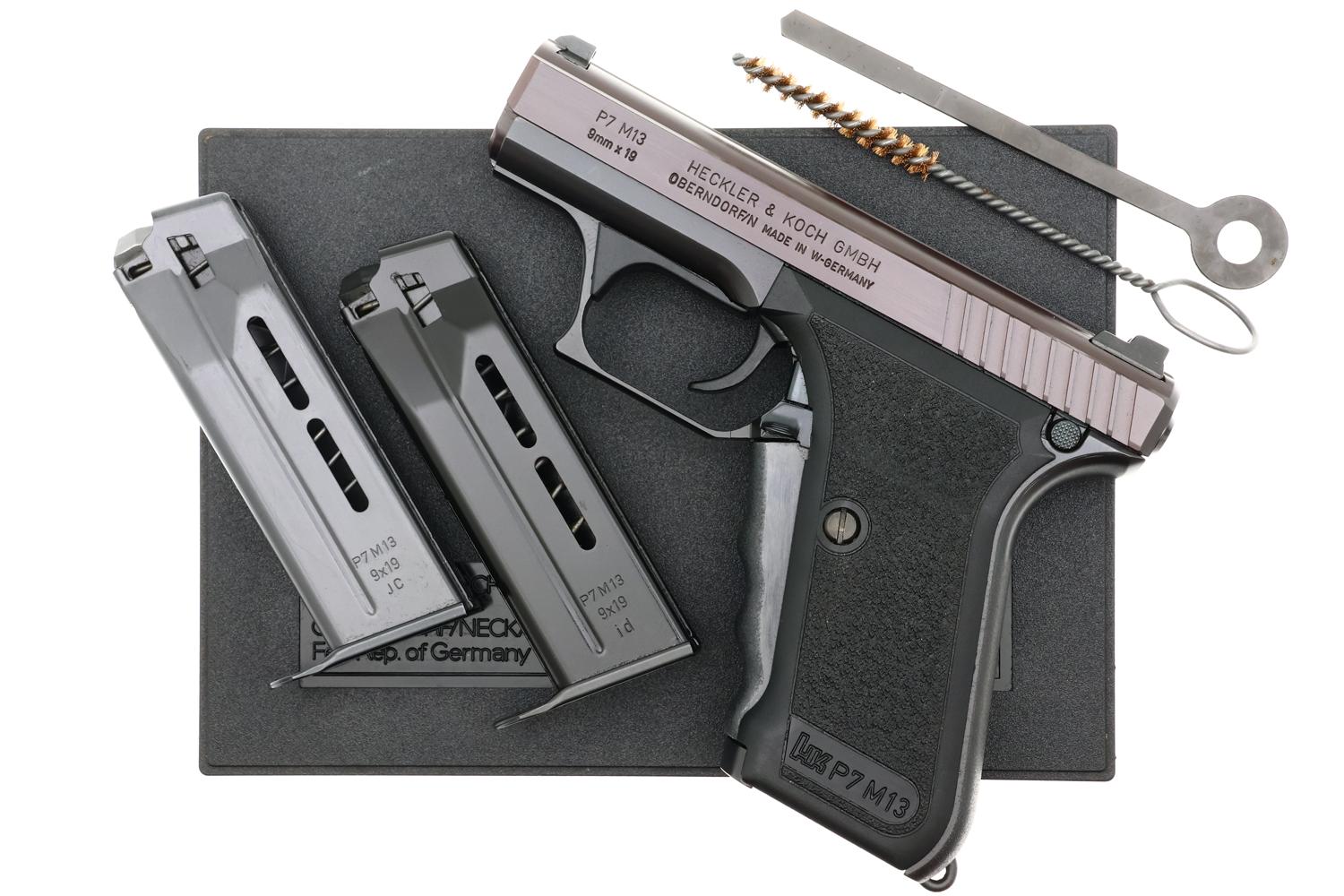
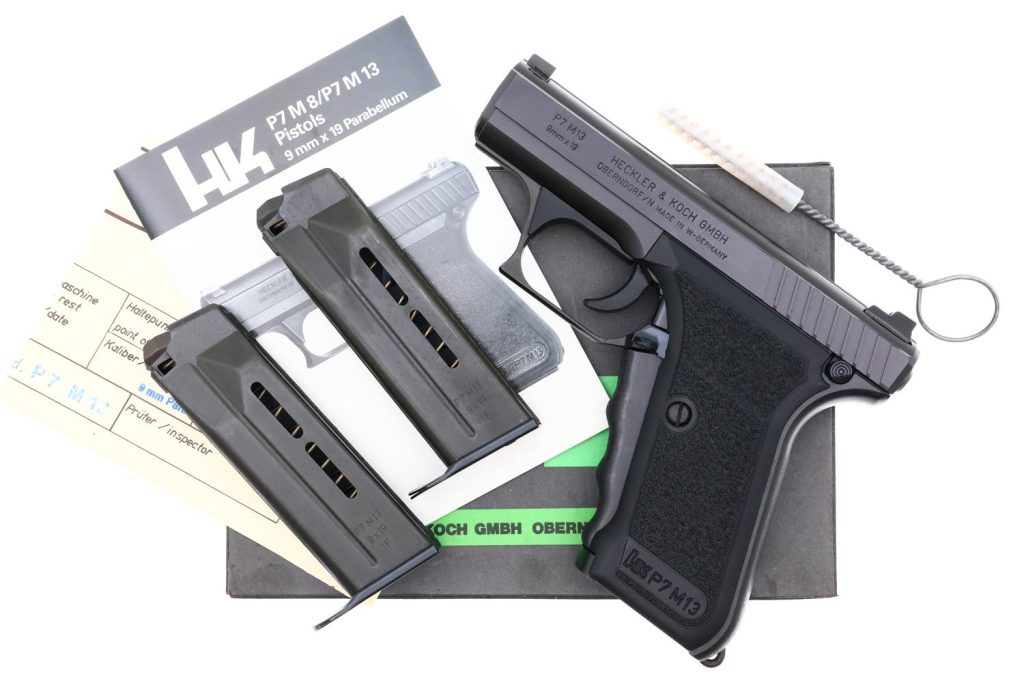
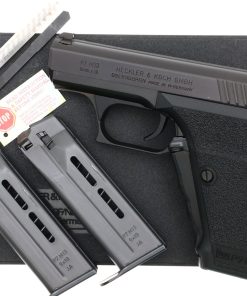
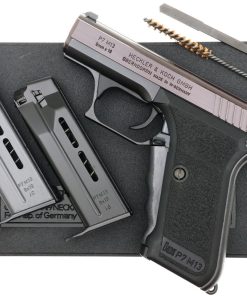
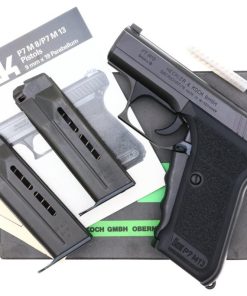
Heckler & Koch P7M13
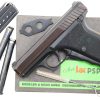
$2,900.00
HK P7M13
Specifications
- Caliber: 9×19mm Parabellum (9mm Luger)
- Action: Gas-delayed blowback, striker-fired
- Magazine Capacity: 13 rounds (double-stack)
- Barrel Length: 105 mm (4.13 in)
- Overall Length: 175 mm (6.9 in)
- Height: 135 mm (5.3 in)
- Width: 33 mm (1.3 in)
- Weight (Unloaded): Approx. 850 g (30 oz)
- Frame: Steel
- Sights: Fixed, contrast points
- Safety: Grip-cocking lever (functions as cocking mechanism and slide release)
- Production Period: 1979–2008 (discontinued)
Heckler & Koch P7M13 semi-automatic Pistol
The Heckler & Koch P7M13 is a German semi-automatic pistol featuring a 13-round double-stack magazine and a unique squeeze-cocking.. Famous for its innovative design and unique squeeze cocking system of operation. It was H&K’s bid to replace the German federal police agency’s aging stock of Walther P.38s. The German government wanted a single, universal, semi-automatic pistol compact and light enough for undercover officers yet capable of firing 9 mm Luger (9×19 mm) ammunition. HK P7M13 is a German semi-automatic, gas-delayed blowback service pistol
featuring a unique front-strap squeeze-cocking mechanism.
HK P7M13 Variants
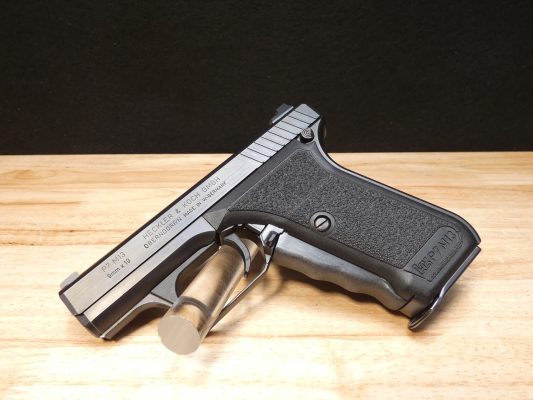
Based on the P7 several other variants were built: the P7PT8, P7M13, P7K3, P7M10 and the P7M7, none of which remain in production. Production of the “P7” heel release design ended in 1997 with the KH date coded pistol marked “P7” on the Grip and “PSP” on the slide.
The P7PT8 is a dedicated, straight blowback training pistol modified for use with the 9×19mm PT training cartridge (made by Geco) with a plastic bullet (weighing 0.42 g). A “floating chamber” adapter is used inside the barrel which enhances felt recoil for use with the special ammunition. The pistols were marked with blue dots on both sides of the slide to differentiate the P7PT8 from other P7 pistols that can chamber lethal ammunition. To date about 200 pistols of this type were produced that are used mainly for simulated firing in enclosed spaces.
The P7M8 is the P7’s counterpart with larger trigger guard, lengthened trigger, heat shield, thumb operated magazine release, larger rear sight dovetail, protruding firing pin bushing and lanyard ring. Production began in 1983 and continued until 2007. A final production run of 500 P7M8 pistols were produced under the AH date code (year 2007). Each is marked on the right side of the slide with X of 500. Other than the slide marking no other features nor accessories were added to the usual kit. To commemorate 25 years of P7 production, H&K offered a limited run of P7M8 “Jubilee” edition. Only 500 examples were ever made. Included in the package were a wooden lockable presentation case, P7 challenge coin, and special markings. The slide’s top-left radiused edge has the designer’s name (Helmut Weldle) and “1 von 500” (German, and including the double quotes; it translates to “1 of 500” in English) etched onto its surface. The wooden grips were made by Karl Nills and had the H&K logo.
The P7M13 is the P7’s counterpart with a double-stack magazine and a 13-round capacity. This pistol was entered to the US Army XM9 pistol trials as a replacement for the aging M1911 pistol, but ultimately lost to the Beretta M9. A variant known as the P7M13SD was produced in limited numbers exclusively for German special forces, featuring a longer (compared to the P7M13) threaded barrel and a sound suppressor. The P7M13 was produced until 2000.
The P7K3 is a shortened version of the P7 (inspired by the HK4 pistol) that uses straight blowback for operation. This version has a removable barrel and uses a sealed hydraulic recoil buffer in place of a gas cylinder. After swapping out the barrel and magazine it can use .380 ACP (9×17mm Short) or .32 ACP (7.65×17mm Browning SR) pistol cartridges and after replacing the slide, magazine and barrel (with floating chamber insert)—it can also be used to fire .22 LR (5.6mm Long Rifle) ammunition. The hydraulic recoil buffer of the P7K3 is prone to wear and causes a serious problem to operate the gun when it is worn down. Heckler & Koch does not make a replacement part for the buffer. However, there are some commercial buffers available. When the .22 LR slide and barrel are installed, the buffer is not engaged. The slide of the .22 LR has an opening at the front that allows the buffer to be unused when firing the gun. Heckler & Koch provides a special scraper tool for the .22 LR-barrel. The tool is needed to clean the inside of the floating chamber for safe operation. An additional exchange tool is provided for all calibers to screw and unscrew the barrel nut that attaches the barrel to the frame. Both tools can be seen in one of the pictures of the P7K3 on this page. P7K3’s are more rare in the U.S. than in Europe and are valued at higher prices especially when they are in good condition.
The P7M10 was introduced to the American market in 1991. It is chambered for the .40 S&W (10×22mm Smith & Wesson) round and has a double-stack 10-round magazine. With the American market in mind, a variant known as the P7M7 designed to use the .45 ACP (11.43×23mm Automatic Colt Pistol) cartridge was also created. However, it remained only a prototype due to excessive costs and complexity of creating such a weapon.
MAC Firearms: Overview, Legality & Purchase Considerations
MAC (Military Armament Corporation) firearms represent a niche segment of the American firearms market, historically recognized for submachine gun designs and contemporary civilian-legal variants. Modern MAC products include semi-automatic pistols and carbines chambered in various calibers including 9mm, .45 ACP, and .380 ACP, marketed toward shooters valuing compact, reliable platforms with historical significance.
Legal Status & State Regulations for MAC Guns
MAC firearms are federally legal semi-automatic weapons complying with National Firearms Act requirements—they are not NFA-regulated items and require no federal registration. However, state-level regulations create significant variations in legality and accessibility. In permissive states (Arizona, Nevada, Texas), MAC firearms may be purchased through standard FFL transactions with NICS background checks and no waiting periods. In restrictive states (California, New York, Massachusetts), MAC products must comply with state-approved rosters, if available, and may face magazine capacity restrictions limiting standard magazines to 10 rounds. Some states prohibit MAC firearms entirely due to their historical military association or cosmetic features classified as “assault weapons.”
Where to Purchase MAC Guns
Licensed dealers specializing in compact or vintage firearms typically stock MAC products. Online retailers (MACguns.shop) facilitate purchases through FFL dealers in the buyer’s jurisdiction. Direct manufacturer purchases through authorized distributors remain common.
MAC Gun Purchase Requirements
All civilian MAC firearm purchases require Federal Firearms License transactions, NICS background checks, and compliance with state-specific waiting periods and permit requirements. Buyers must be 21 years old minimum for handguns, 18 for rifles/carbines. State-specific regulations—particularly regarding magazine capacity, cosmetic features, and ownership permits—must be verified before purchase, as MAC firearms legal in one state may be prohibited in another.
Be the first to review “Heckler & Koch P7M13”
Related products
Unicorn Firearms
Unicorn Firearms
Unicorn Firearms
Unicorn Firearms
Unicorn Firearms
Unicorn Firearms
Reviews
There are no reviews yet.