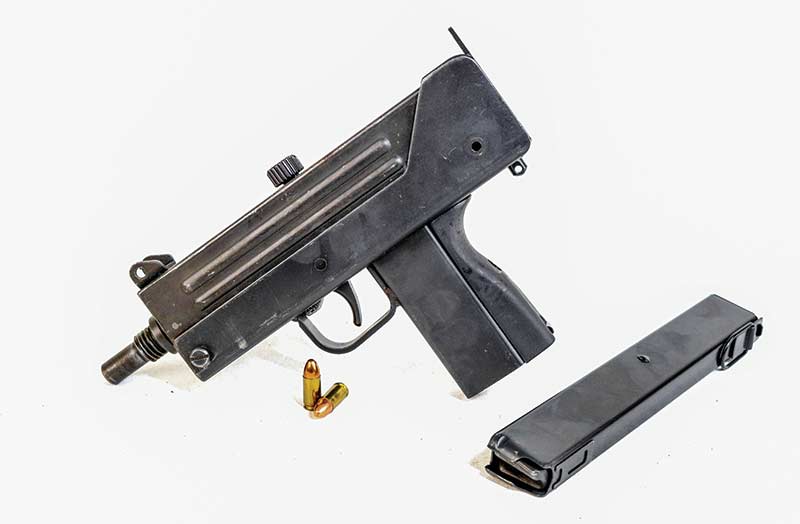
MAC-10 Compact Handgun 9mm/.45ACP
$1,999.98
MAC-10
Key Specifications
- Caliber: .45 ACP or 9x19mm Parabellum.
- Weight: ~6.26 lbs (2.84 kg – 3.1 kg) empty.
- Length: ~11.6 in (269mm) with stock retracted; ~21.5 in (548mm) with stock extended.
- Barrel Length: 5.75 inches (146mm).
- Rate of Fire: ~1,050–1,200 rounds per minute.
- Effective Range: ~50 meters (.45 ACP) to 70 meters (9mm).
- Feed System: 30-round (.45 ACP) or 32-round (9mm) detachable box magazines.
- Operation: Open bolt, blowback.
MAC-10 Compact Handgun 9mm/.45ACP
Design
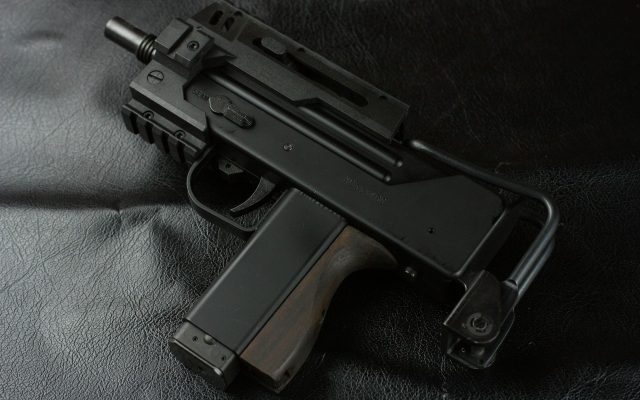
The MAC-10 is built predominantly from steel stampings. A notched cocking handle protrudes from the top of the receiver, and turning the handle 90°, locks the bolt, and acts as an indicator the weapon is unable to fire. The MAC-10 has a telescoping bolt, which wraps around the rear face of the barrel. This allows a more compact weapon and balances the weight of the weapon over the pistol grip, where the magazine is located. The MAC-10 fires from an open bolt, and the light weight of the bolt results in a rapid rate of fire. In addition, this design incorporates a built-in feed ramp as part of the trigger guard (a new concept at the time) and, to save on cost, the magazine design was recycled from the M3 Grease Gun. The barrel is threaded to accept a suppressor, which works by reducing the discharge’s sound without attempting to reduce the speed of the bullet. The .45 ACP models are well-suited for this, as most .45 loads are naturally subsonic, as opposed to the specialized subsonic loads usually required for suppressed 9mm weapons. At the suggestion of the United States Army, the suppressor also acts as a foregrip to inhibit muzzle rise when fired. Ingram added a small bracket with a small strap beneath the muzzle to aid in controlling recoil during fully automatic fire. The original rate of fire for the MAC-10 in .45 ACP is approximately 1090 rounds per minute. That of the 9mm is approximately 1250, and that of the smaller MAC-11 in .380 ACP is 1500 rounds per minute.
Noting the weapon’s poor accuracy, in the 1970s, International Association of Police Chiefs weapons researcher David Steele described the MAC series as “fit only for combat in a phone booth”.
Suppressor
One of the features that brought early attention to the MAC-10 was its sound suppressor, designed by Mitchell WerBell III of Sionics. The suppressor uses a two-stage design, with a wider first section followed by a narrower second section, giving it a distinctive stepped profile.
When used with subsonic ammunition, the suppressor substantially reduces the sound of firing. Under these conditions, the mechanical noise of the bolt cycling is often more noticeable than the muzzle report. Standard .45 ACP ammunition is subsonic and commonly used with the suppressor.
A heat-resistant Nomex cover can be fitted over the suppressor, allowing it to be used as a forward gripping surface while protecting the user from heat buildup.
During the 1970s, U.S. export restrictions on suppressors led several international customers to cancel orders, as the suppressor was a key feature of the MAC-10. This reduction in sales was one factor that contributed to the financial failure of the Military Armament Corporation.
The original Sionics suppressor measures approximately 29.1 centimetres (11.44 inches) in length, has an overall diameter of 5.4 centimetres (2.13 inches), and weighs about 0.54 kilograms (1.20 pounds).
Calibers and variants
While the original M10 was available chambered for either .45 ACP or 9mm, the M10 is part of a series of machine pistols, the others being the MAC-11/M-11A1, which is a scaled-down version of the M10 chambered in .380 ACP (9×17mm); and the M-11/9, which is a modified version of the M-11 with a longer receiver chambered in 9×19mm, later made by SWD (Sylvia and Wayne Daniel), Leinad and Vulcan Armament. Law enforcement bureaucracies such as the Minnesota Bureau of Criminal Apprehension (BCA) consider MAC-11 variants such as the Leinad PM-11 to be part of the “MAC-10 class pistol”.
In the United States, machine guns are National Firearms Act items. As the Military Armament Corporation was in bankruptcy, a large number of incomplete sheet metal frame flats were given serial numbers and then bought by a new company, RPB Industries. Some of the previously completed guns, which were already stamped with MAC, were then stamped with RPB on the reverse side, making it a “double stamp” gun.
RPB Industries made many open-bolt semi-automatic and sub-machine guns before the Bureau of Alcohol, Tobacco, Firearms and Explosives (ATF) seized roughly 200 open-bolt semi-autos during the drug wars of 1981. The ATF insisted that all future semi-automatic firearms were to be manufactured with a closed-bolt design as the open-bolt semi-automatics were considered too easy to illegally convert to full automatic operation.
Semi-automatic variants, Mk III, IV and V were marketed to South American countries where “military” calibers were forbidden for civilian sales were chambered in .30, .41 and .50 Ingram respectively and available as semi-automatic pistols/carbines.
Wayne Daniel, a former RPB machine operator, purchased much of their remaining inventory and formed SWD, designing a new weapon which was more balanced, available either fully or semi-automatic with his new BATFE-approved closed bolt design.
There are several carbine versions of the M-11/9 and Cobray and SWD manufactured a smaller version chambered in .380 ACP as a semiautomatic pistol called the M-12.
Today, while the civilian manufacture, sale and possession of post-1986 select-fire MAC-10 and variants is prohibited, it is still legal to sell templates, tooling and manuals to complete such conversions. These items are typically marketed as being “post-sample” materials for use by Federal Firearm Licensees for manufacturing/distributing select-fire variants of the MAC-10 to law enforcement, military and overseas customers.
Key Details of the MAC-10
History & Usage
Be the first to review “MAC-10 Compact Handgun 9mm/.45ACP”
Related products
MAC Firearms
MAC Firearms
Unicorn Firearms
MAC Firearms
MAC Firearms
MAC Firearms
Unicorn Firearms
MAC Firearms
Reviews
There are no reviews yet.